 English
 Español
The best adhesive for skirting boards is not a single product but a category. In most interior installations, a high-performance grab adhesive based on MS polymer or a hybrid formulation gives the strongest balance of immediate hold, long-term flexibility, and gap-filling ability. It works on painted, primed, and raw boards, and it avoids the brittleness that leads to visible cracks along the joint.
Before choosing, check three factors: the wall surface condition, whether the board is primed or bare, and how much weight the skirting must support. These variables decide whether an acrylic-based product is enough or whether you need a stronger polyurethane or a two-part system.
What Makes an Adhesive Reliable for Skirting Boards?
Not every glue sold for decorative trim is actually suitable for skirting boards. The key distinction is between products that hold immediately and those that cure slowly but create a more permanent bond. For skirting, you need both, because the board has to stay in place while you work on mitres and fill nail holes.
Initial grab strength
This is the ability of the adhesive to hold the board against the wall without support. A good grab adhesive gives you 20 to 30 minutes of repositioning time, but it should hold a 15 kg board in place as soon as you press it against the wall. Low-grab products are a common cause of skirting slipping before the adhesive cures.
Curing time
Most hybrid and polyurethane adhesives reach full strength in 24 to 48 hours. Some fast-curing formulations are ready for light handling in 6 to 8 hours, but the maximum bond develops over two days. If you plan to paint the next morning, check the label for the earliest paint-ready time.
Long-term flexibility
Walls and floors expand and contract with humidity and temperature. A rigid adhesive can crack after a few months, creating a visible seam that is hard to repair. Flexible adhesives absorb this movement and keep the joint concealed. This matters most for skirting installed over new plaster or near heating sources.
Gap-filling ability
Interior walls are rarely perfectly flat. A reliable adhesive should fill gaps of 5 to 8 mm without sagging or forming air pockets. This allows you to bed the board firmly against an uneven surface rather than forcing it into contact.
The best adhesive for skirting boards is the one that lets you press the board into place, count to twenty, and know it will still be there tomorrow.
MDF vs Pine vs Solid Wood: Does the Substrate Change Your Adhesive Choice?
Skirting boards look similar from the front, but the substrate behind the painted surface changes how you should apply adhesive and how much you need.
MDF skirting boards
MDF is dense, absorbent, and free of natural grain movement. It is heavier than pine, so it needs a fuller bead pattern. A 3 to 5 mm continuous bead of MS polymer or hybrid grab adhesive applied in a zig-zag or double-line pattern gives reliable results on most walls. MDF also works well with PVA-based products, but avoid water-rich adhesives on unpainted cut edges because moisture can swell the board.
If you are working with primed boards that are ready for final painting, a primed MDF skirting board supplies a consistent surface for the adhesive and reduces the risk of uneven absorption.
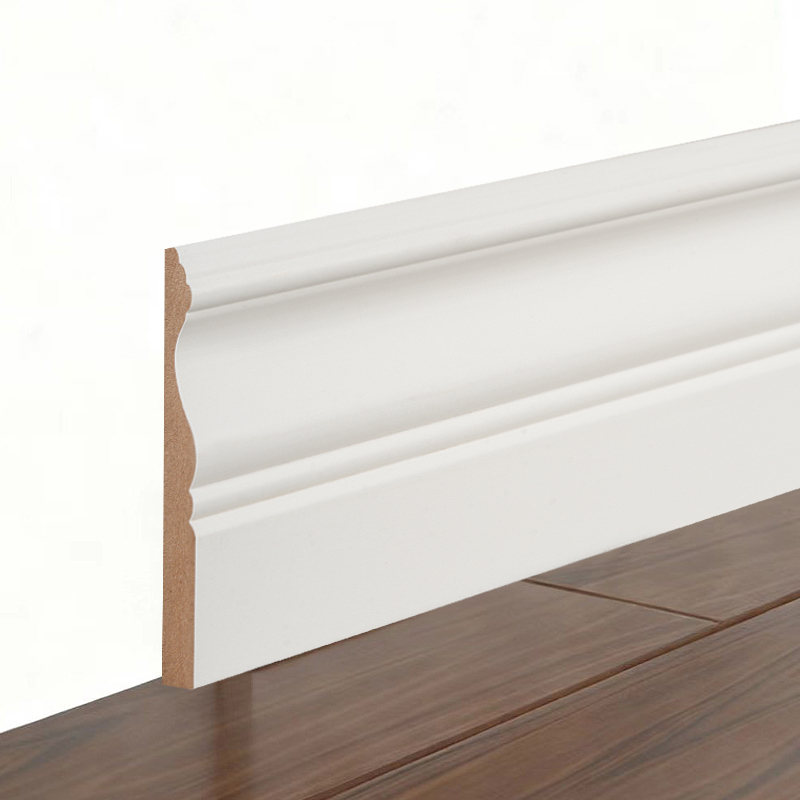 Filler-Primed MDF Skirting Board with Pearl White FinishThis high-density MDF skirting board comes filler-primed and pearl white, offering a smooth, ready-to-paint surface. It suits interior renovations where a consistent base helps adhesives bond evenly and reduces uneven absorption.View Product →
Pine wood skirting boards
Pine is light, fibrous, and often supplied with a white primer. It accepts most adhesives, but water-based PVA can raise the grain if it contacts unprimed sections. A fast-curing hybrid or a solvent-free polyurethane is the safer option. Pine is also more forgiving if the wall is uneven because the board can flex slightly.
For a ready-to-install option with a factory-applied primer, a pine wood skirting board eliminates the need for sealing before applying adhesive.
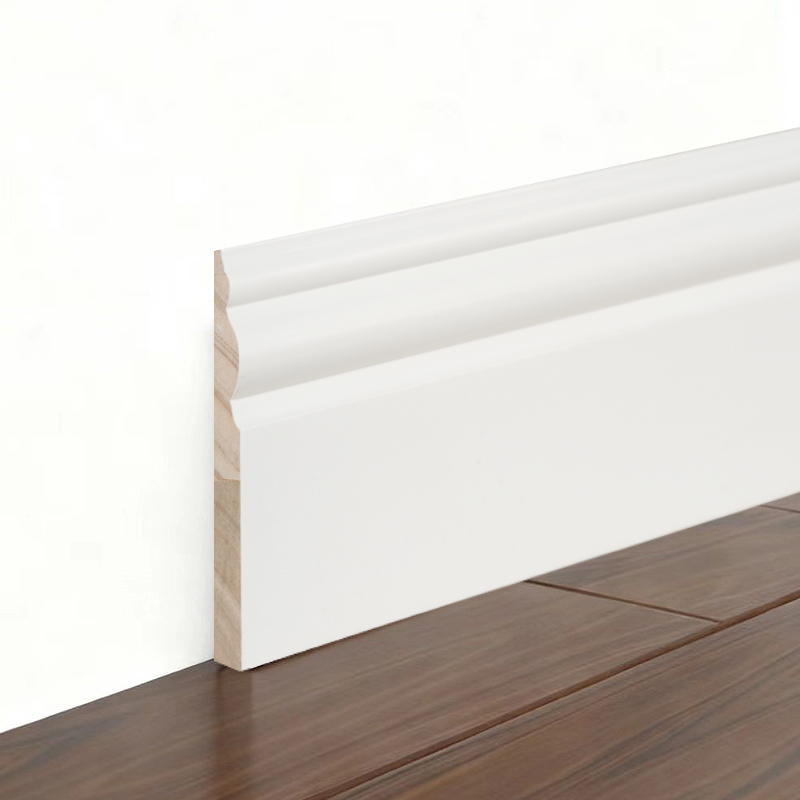 Pine Skirting Board with Factory-Applied Primer and Pearl White FinishMade from radiata pine, this primed skirting board eliminates the need for sealing before bonding. Its light, fibrous nature flexes slightly on uneven walls, making it a forgiving option for quick installations.View Product →
Solid wood skirting boards
Solid wood is heavier and stronger than both MDF and pine. Use a high-modulus adhesive or a polyurethane with strong vertical shear strength. In high-traffic areas and on long runs, combine adhesive with screws or pins at the mitre joints. If the skirting is unfinished, apply the adhesive only to the back face and avoid contact with the visible face.
A red oak solid wood skirting demonstrates how a factory-applied paint finish on solid wood reduces surface preparation while still requiring a strong adhesive system.
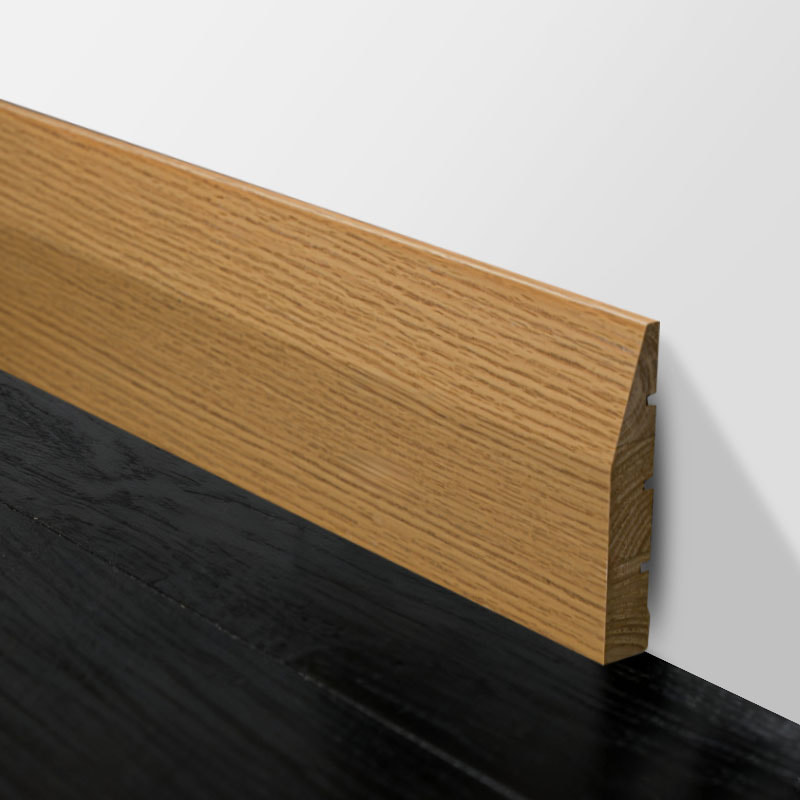 Solid Wood Skirting Board Wrapped in Red Oak VeneerThis solid wood skirting features a red oak veneer and painted finish, providing a natural timber look with stability. It requires a strong adhesive system, especially in high-traffic areas or long runs.View Product →
| Substrate | Recommended adhesive type | Bead spacing | Mechanical fixing |
|---|---|---|---|
| MDF | MS polymer or hybrid grab adhesive | 150 to 200 mm | Not required for indoor |
| Pine | Fast-curing hybrid or solvent-free polyurethane | 200 to 250 mm | Only for long runs |
| Solid wood | High-modulus polyurethane | 100 to 150 mm | Recommended at joints |
Comparing Adhesive Types: Grab, Silicone, and Polyurethane
Three product families dominate the skirting adhesive market. Each behaves differently in a way that affects installation speed, durability, and how the board looks after a year.
| Adhesive type | Initial grab | Typical cure | Flexibility | Best use |
|---|---|---|---|---|
| Hybrid / MS polymer | High | 24 to 48 hours | Very high | Most modern skirting boards |
| Silicone | Medium | 24 hours | Excellent | Tight joints and damp areas |
| Polyurethane | Very high | 12 to 24 hours | Medium | Solid wood and high-impact zones |
Hybrid and MS polymer adhesives are the best all-round choice for skirting. They combine strong initial grip with high flexibility, which prevents stress cracks at the joint. Silicone is useful when you need a waterproof seal in bathrooms or near windows, but its lower immediate grab means the board can slide before curing. Polyurethane is excellent for solid wood and external-grade applications, but it tends to foam slightly and is harder to clean up if it reaches the room-facing surface.
Surface Preparation and Application Steps
Preparation matters more than the adhesive itself. If the wall is dusty or the back of the board is loose, no adhesive will perform correctly. A dry brush, a damp cloth, and a spirit level will do more for the final result than switching to a stronger glue.
- Clean the wall and the back of the board with a dry brush. Remove dust, flaking paint, and loose plaster.
- Fill major irregularities with decorators' filler and let it dry. The adhesive should not be used to bridge gaps larger than 8 mm.
- Check wall moisture with a meter. Readings above 20 percent mean the adhesive may not cure properly and the board could lift later.
- Apply a continuous 10 mm bead along the top and bottom edges. For longer boards, use a zig-zag pattern across the middle to distribute the load.
- Press the board firmly into place, check the level, and use a temporary brace for the first hour if the wall is very uneven.
- Allow 24 to 48 hours of full cure before filling nail holes or applying the final coat of paint.
For a more detailed walkthrough of adhesive-only installation and mitre joints, read our article on nail-free fixing and mitre joint techniques.
A straight bead on a clean wall is worth more than an expensive tube of adhesive applied to a dusty surface.
Common Installation Mistakes to Avoid
Most skirting failures do not come from the adhesive itself. They come from technique and material selection errors that are easy to prevent.
- Using a thin, fast-drying adhesive on uneven walls. The board bridges the gap and leaves a visible hollow that appears after the adhesive cures.
- Applying adhesive to only one edge of a long board. The free edge can flex and separate from a wall that is not perfectly flat.
- Relying on adhesive alone for solid wood boards longer than 2.4 metres. Wood movement can overpower the bond. Use screws or pins at the mitre joints.
- Painting before the adhesive has fully cured. Solvents in the paint can weaken the joint and cause the skirting to bow slightly after a few weeks.
These issues are avoidable with the right product and a simple supporting fix. When you are selecting skirting for a new project, compare skirting board materials to match the substrate with the installation conditions.
Frequently Asked Questions
Q1: Can I use the same adhesive for MDF and solid wood skirting?
Yes, but choose a flexible hybrid product. MDF needs less water content than solid wood, so avoid solvent-based adhesives on unpainted MDF edges. For solid wood over 2.4 metres long, use a polyurethane or a two-part system.
Q2: How long should I wait before painting?
At least 24 hours, ideally 48. Some fast-curing formulations allow painting after 8 hours, but always check the manufacturer label. The adhesive needs full cross-linking before paint stresses the joint.
Q3: Is silicone adhesive good for skirting boards?
Silicone works well for joints and damp areas, but its lower initial grab means boards can slide during installation. If you use silicone, support the board with a brace until it cures.
Q4: Do I still need nails if I use adhesive?
For most indoor MDF installations up to 2.4 metres, adhesive alone is sufficient. For solid wood, high-traffic areas, or very long runs, mechanical fixing at the mitre joints gives extra security.
Final Recommendation
The strongest and most forgiving choice for most skirting projects is a hybrid MS polymer adhesive. It offers enough initial grab to hold the board in place, enough flexibility to accommodate wall movement, and enough gap-filling capacity for imperfect surfaces. If you are fixing solid wood or longer runs, pair the adhesive with screws or pins at the mitre joints for a durable, maintenance-free result.
Choosing the right adhesive is only part of the job. The other half is selecting skirting boards that match your wall type and your finishing plan. Compare primed MDF, pine, and solid wood options to confirm the board you install will work with the adhesive you choose.