 English
 Español
Start with the environment, not the catalogue. A skirting board that looks elegant in a showroom can become a problem within a year when it meets a damp exterior wall, a busy corridor, or a painter who has to fill every exposed grain before the first coat. The practical order of decisions is simple: choose the material for the room and the floor, set the height for the ceiling and the flooring work, then choose the finish for the installation workflow. Once those three decisions are correct, the profile becomes a styling preference instead of a risk.
The three decisions that determine everything else
1. Material, chosen for the environment and the floor type.
2. Height and profile, chosen for the ceiling height and room style.
3. Finish, chosen for the site workflow and long-term maintenance.
Match the Material to the Room and the Floor
The material decides how the board reacts to moisture, impact, and site painting. No single material wins everywhere; the right one depends on where the board will live and what will happen around it.
- MDF (medium-density fibreboard): dense, smooth, and dimensionally stable, with very little surface preparation needed before painting. Its weakness is impact, and prolonged direct water contact can swell the edges.
- Primed pine: notably more impact-resistant than MDF, and it can be sanded and repainted several times over its life. It needs a good quality primer so that knots and grain do not telegraph through the final paint.
- PVC wrapped: a primed core covered with a durable foil. It needs no site painting, resists moisture and cleaning products, and keeps colour consistent across long runs, which makes it the realistic choice for bathrooms, kitchens, and rental flats.
- Solid hardwood (oak, walnut): the premium option with a real wood grain that can be stained or painted. It is more expensive, needs climate acclimation before installation, and expands and contracts with humidity changes.
For a typical painted living room or bedroom on dry, level walls, a filler-primed MDF or pine board combines squareness, paintability, and cost better than any other option. For bathrooms, kitchens, and everyday commercial corridors, a PVC-wrapped board removes the painting step and tolerates occasional splashes far better than bare MDF.
| Material | Best for | Moisture resistance | Impact resistance | Site painting | Relative cost |
|---|---|---|---|---|---|
| MDF | Painted rooms, long straight runs | Moderate | Low | Recommended | Low |
| Primed pine | Homes with children or pets | Moderate | Good | Primer plus topcoats | Medium |
| PVC wrapped | Bathrooms, kitchens, rentals | High | High | Not required | Medium |
| Solid hardwood | Feature rooms, natural grain | High when sealed | Good | Not typical | High |
If the project is a standard painted interior, a primed MDF board with a smooth face reduces sanding time and keeps the painted finish even over long runs.
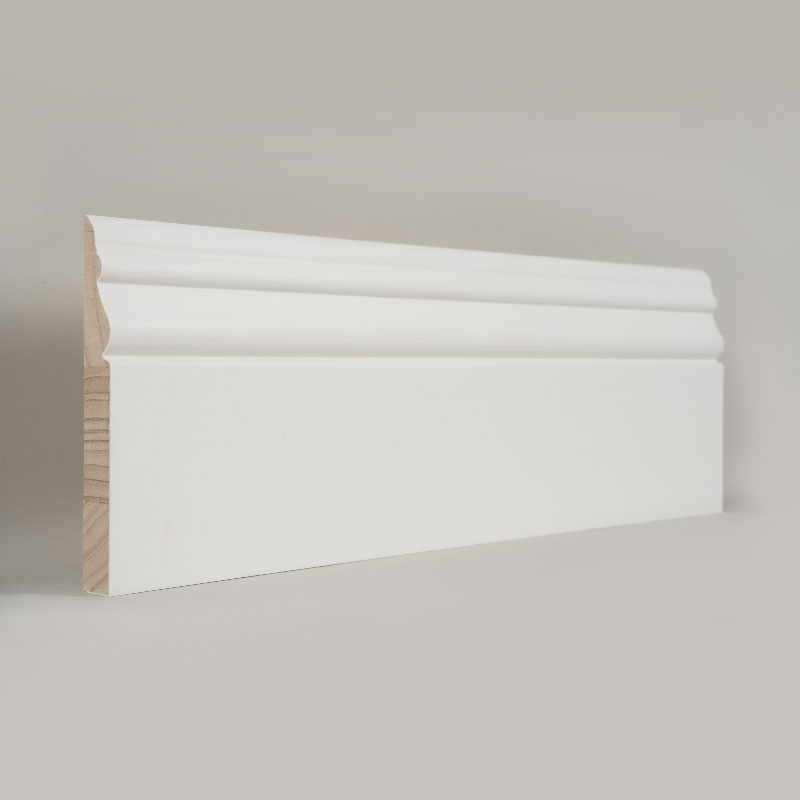
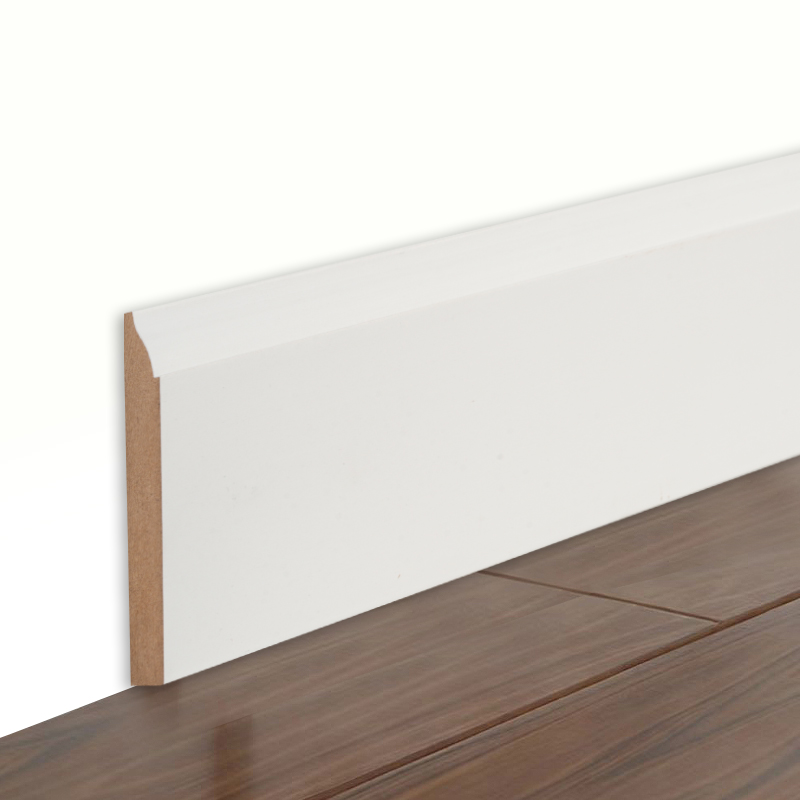 Filler-Primed MDF Skirting Board in Pearl White, 3/5" x 4 1/4"This primed MDF board offers a smooth surface that reduces sanding and ensures an even painted finish, making it a practical choice for standard painted interiors and clean wall-to-floor transitions.View Product →
Set the Height by the Ceiling and the Flooring
Height is the first thing the eye reads, and it is also a practical cover-up tool. A board that is too short leaves a visible gap above a floating floor; a board that is too tall can dominate a small room.
Quick height reference
2.4 m ceiling: 80 to 120 mm
2.7 m ceiling: 120 to 150 mm
3 m and higher: 180 to 250 mm or more
Check the floor detail before ordering. A floating floor needs an expansion gap of roughly 10 to 15 mm around the perimeter, and the skirting must be tall enough to cover that gap plus the finished height of the floor. If the walls are uneven, a taller board can also accommodate more surface deviation without showing a wavy joint at the top edge.
The profile is the second half of the sizing decision. Square-edged and chamfered profiles suit minimalist interiors; a bullnose softens the top edge and reads warmer; an ogee or scotia profile carries traditional detail. Keep the profile consistent with the architraves and door linings in the same room, because mismatched profiles become obvious wherever two mouldings meet.
Square edgeChamferedBullnoseOgeeScotia
When the skirting will be painted on site and the room gets regular knocks, primed pine is a sensible choice because it resists impact better than MDF and can be sanded and repainted later.
Choose the Finish for the Installation Workflow
The finish determines how much labour remains on site and how durable the surface will be over time. For trade buyers, this is often the difference between a one-day install and a three-day install.
- Filler-primed white: a factory-sealed base ready for one or two topcoats. It gives the painter maximum colour flexibility and is the most common choice for residential paint schemes.
- Fully painted: the board arrives white or in a fixed colour such as Swiss white or Munich, ready to install with no further coating. Ideal for schedules where painting labour is scarce or expensive.
- PVC wrapped: a foil covering that needs no painting, tolerates moisture and regular cleaning, and keeps colour consistent across the whole order. Common in bathrooms, kitchens, and rental properties.
- Veneer wrapped: a real wood skin over a stable core, giving a natural grain appearance without the movement or cost of solid timber.
On any project longer than 50 linear metres, the cost of site painting, including filling, sanding, masking, and two topcoats, usually exceeds the price difference between primed and prefinished boards. Contractors notice this first.
On smaller renovations, primer-finished boards are often preferred because the painter can blend the board perfectly with the wall colour. On commercial fit-outs and large housing projects, prefinished boards reduce the number of trades on site and give a uniform result without relying on the painter's consistency.
When the colour is fixed and the schedule is tight, a white prefinished board arrives ready to install with no further coating work.
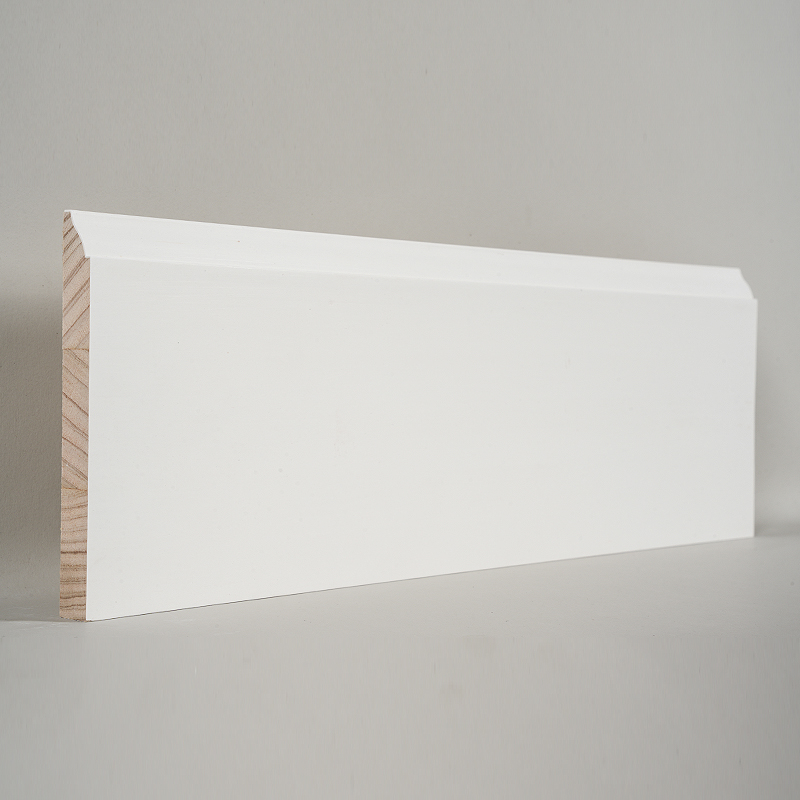
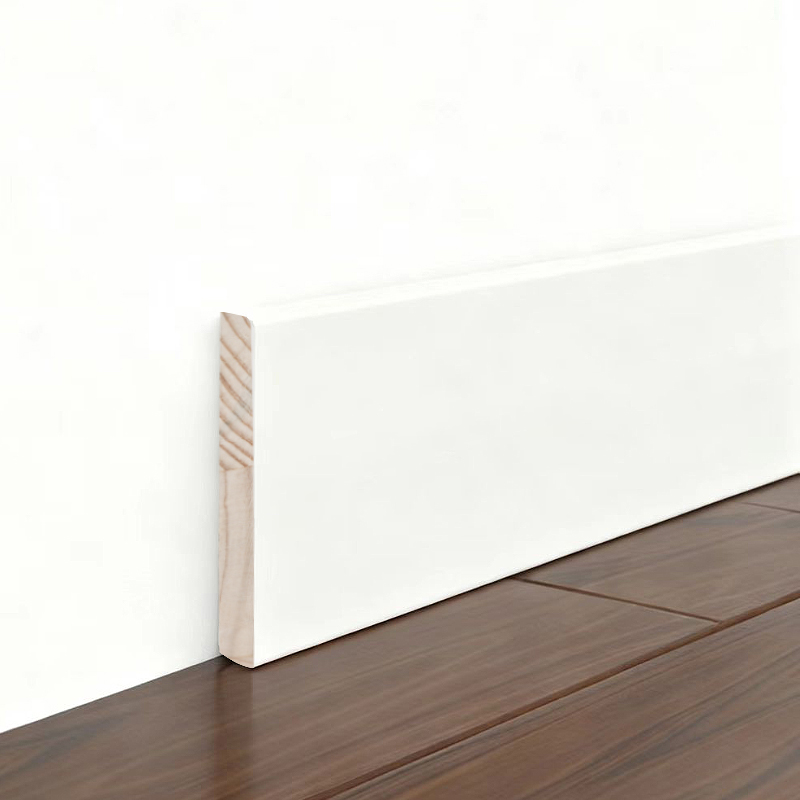 Prefinished White Pine Wood Skirting Board, 3/5" x 3 1/6"A ready-to-install white pine skirting board with a factory-applied paint finish, suitable for tight schedules and complementing new flooring when coordinating transition strips and trims.View Product →
Order the Full Package, Not Just the Board
A skirting board does not finish a room on its own. Internal corners are usually mitred or coped, external corners need clean mitres, and the gap between the board and a floating floor is often closed with a scotia or quarter-round profile. If the project includes new floors, the transition strips, stair nosings, and reducers should be specified at the same time so the colour and paint system match the skirting.
Measure the perimeter of each room, add 5 to 8 percent for waste and pattern matching, then round up to the nearest standard length. Always buy the full quantity from one production batch. Batch-to-batch differences, even among primed boards, can become visible on a long uninterrupted wall.
For large orders, the supplier's production consistency matters more than the unit price. A factory running continuous coating lines can hold colour and dimension stable across thousands of metres, which is what a contractor needs when the same board runs through an entire building. Our guide to choosing the right types of skirting boards explains how the main categories differ in cost, durability, and installation effort, and the full product range on this site shows how architraves, quarter rounds, and transition strips are designed as one matching system.
For feature rooms where the board is meant to be seen, a prefinished solid wood profile in oak or walnut gives a furniture-grade result and long service life.
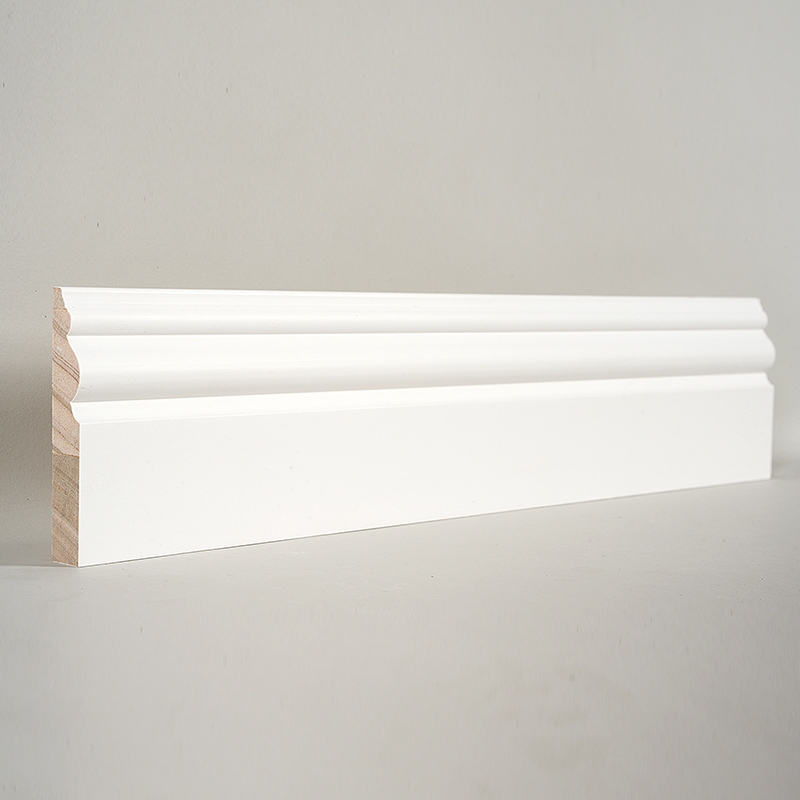
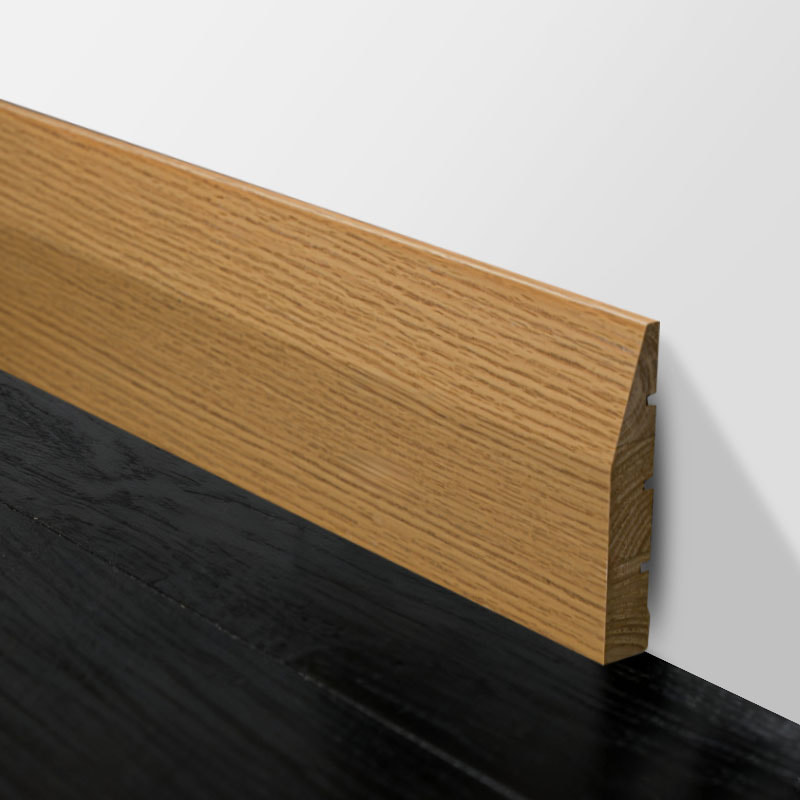 Solid Wood Skirting Board Wrapped in Red Oak Veneer, Oak Color, 3/5" x 3 15/16"This solid wood profile with red oak veneer delivers a natural timber look and durable surface, ideal for feature rooms where the board is meant to be seen and long service life is valued.View Product →
Frequently Asked Questions
Q1: Which is better for skirting boards, MDF or solid wood?
For painted interiors, MDF is usually the better value because it is stable, smooth, and easy to paint. Solid wood is better when you want a natural grain finish or when the board will need to be sanded and repainted several times over its life, for example in a house with children or pets.
Q2: What is the standard height for skirting boards?
There is no fixed standard. With a 2.4 m ceiling, 80 to 120 mm is common; with 2.7 m ceilings, 120 to 150 mm; in period-style rooms with higher ceilings, 180 to 250 mm or more. The board must always cover the gap between the floor and the wall, including the expansion gap required by a floating floor.
Q3: Can I install skirting boards in a bathroom?
Yes, but avoid bare MDF. Choose a PVC-wrapped board or a fully sealed solid wood board so moisture cannot swell the core. A painted MDF board can work if the joints are sealed well, but PVC removes the risk entirely.
Q4: Are prefinished skirting boards worth the extra cost?
When site labour is expensive or the programme is tight, prefinished boards usually pay for themselves. A primed board still needs filling, sanding, and at least one topcoat on site, and those operations carry their own material and labour costs.
One practical last note: choose the skirting after the floor and the wall finish have been decided, not before. The floor supplier can tell you the finished floor height and the expansion requirement, and the wall finish determines whether a primed or prefinished board saves more time. With the material set for the environment, the height set for the room, and the finish set for the workflow, the only thing left is the profile you will live with for the next decade.