 English
 Español
Walk into a newly built living room with 11-foot ceilings, and the first thing you notice is the volume overhead. The second thing you notice, once the excitement fades, is the transition between the wall and the ceiling. A 2-1/2-inch strip of trim designed for a standard 8-foot room simply gets lost at that height.
Crown moulding for high ceilings is a different product decision than crown for standard rooms. The profile must carry more visual weight, the material must hold its shape across longer runs, and the finish has to hide seams that are far too high to touch up comfortably. Get these three decisions right, and the room looks intentional. Get them wrong, and no amount of paint will fix it.
How to Size Crown Moulding for High Ceilings
The first decision is dimension, and it has a simple starting rule: the taller the wall, the taller the crown face. A workable formula used by trim carpenters is to allocate roughly half an inch of crown height for every foot of ceiling height. That puts a 9-foot ceiling in the 4-1/2- to 5-inch range, a 10-foot ceiling in the 5- to 6-inch range, and a 12-foot ceiling at 6 to 7 inches.
Profiles smaller than that carry too little shadow on a tall wall. The crown moulding visually disappears, and the room looks unfinished at the top. At the other extreme, an oversized profile creates a heavy, top-heavy feel that competes with coving or tray details.
| Ceiling Height | Recommended Crown Height | Visual Effect |
|---|---|---|
| 8 ft (96 in) | 2.5–3.5 in | Classic, proportional to standard rooms |
| 9 ft (108 in) | 3.5–5 in | Clear presence without dominating |
| 10 ft (120 in) | 5–6.5 in | Strong architectural statement |
| 12 ft+ (144 in+) | 6.5 in or stacked profiles | Monumental, custom millwork feel |
Quick takeaway: for most homes, choose a crown face height that is at least half the ceiling height in feet — 5 inches for a 10-foot room, 6 inches for a 12-foot room.
For the most common 10-foot condition, a single 5- to 6-inch profile is usually enough. When the room exceeds 12 feet, a second smaller profile, such as a cove or quarter round installed below the main crown, is a practical way to build visual depth without ordering a fully custom knife.
MDF, Pine, or Solid Wood for Tall Walls
After size, the material choice has the largest effect on both cost and long-term performance. The three options that dominate crown moulding for high ceilings are MDF, pre-primed pine, and solid hardwood. Each behaves differently at height.
MDF crown moulding
Medium-density fiberboard is the workhorse for painted crown moulding in tall rooms. It machines cleanly, takes a smooth and uniform paint coat, and expands very little across long runs compared with solid wood. In a room with raking light from large windows, MDF’s grain-free surface is a genuine advantage: no knots or fiber patterns telegraph through the paint film. MDF also costs 30–50 percent less than solid wood at equivalent dimensions, which matters when a single room needs 80 to 120 linear feet of profile. The trade-off is weight and a harder surface that requires pilot holes near cut ends.
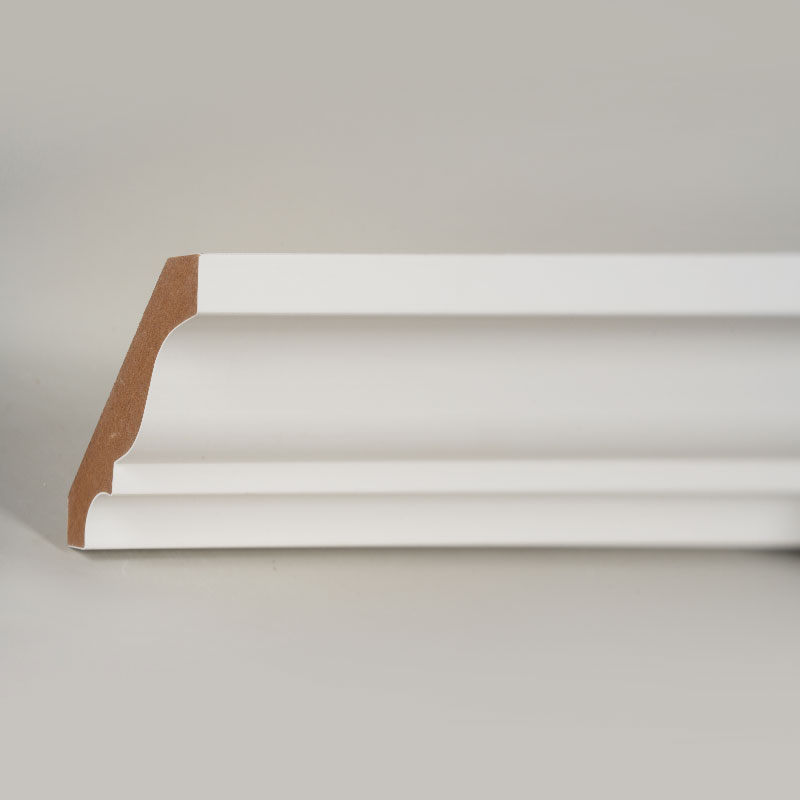
 MDF Crown Moulding (Filler-Primed & Pearl White) 3/5" x 4 1/4"Product Details Sturdy, Eco-Friendly Core: The core substrate is made of high-density, eco-friendly MDF. Its dense internal fiber structure provides strong support, en...View Product →
Pine crown moulding
Pre-primed pine is the classic alternative. Pine is lighter than MDF, cuts cleanly with standard miter saw blades, and is forgiving when you need to scribe or trim on site. The filler-primed pearl white finish used in our pine line seals the grain, so you get the structural lightness of wood with a surface that accepts a final top coat without extensive sanding. If your project calls for stain or a translucent finish, select unprimed pine and apply your own sealer. For a closer look at how pine behaves in crown applications, see our guide to transforming interiors with pine wood crown moulding.
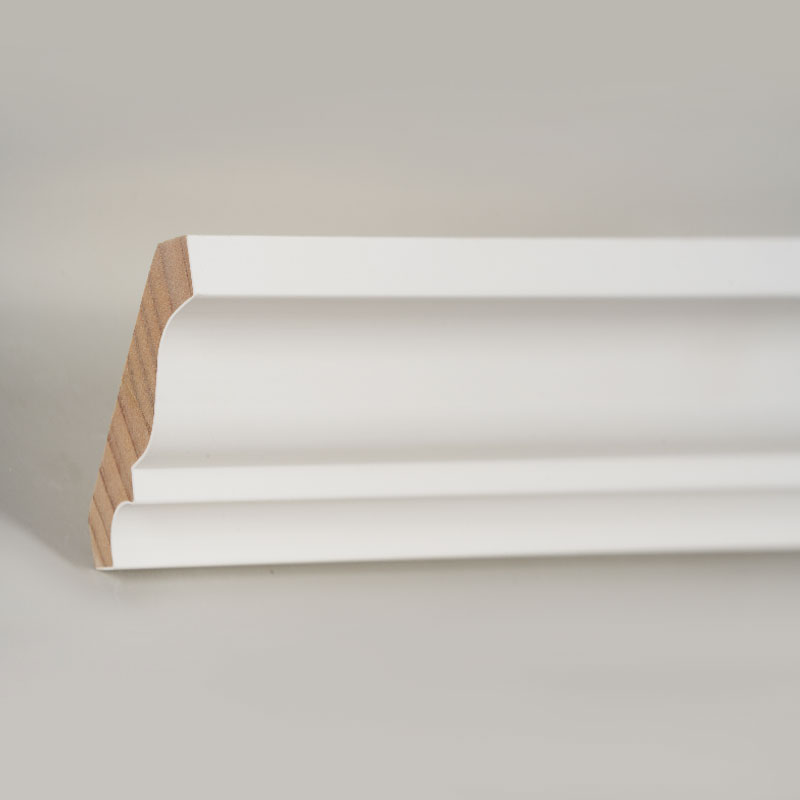
Pine Wood Crown Moulding (Filler-Primed & Pearl White) 3/5" x 6"Product Details Aesthetic Fusion: Utilizing natural radiata pine wood, this wood is combined with a modern mud coating process to create a unique surface texture. Whil...View Product →
Solid hardwood crown moulding
Solid wood comes into its own when the architecture calls for a stained finish, or when ceilings exceed 14 feet and the trim needs real mass. Red oak, white oak, and black walnut are the species we most commonly run in this category. The caveats are practical ones: solid stock must acclimate to the room’s humidity, and seasonal movement can open scarf joints if the profile is very wide. For a painted install at 9 to 12 feet, MDF or pine is generally the safer engineering choice.
| Material | Dimensional Stability | Paint Surface | Relative Cost | Best Use Case |
|---|---|---|---|---|
| MDF | High | Very smooth, grain-free | $ | Painted high ceilings, long runs |
| Pine (primed) | Medium | Good, slight grain texture | $$ | Painted or stained, DIY installs |
| Solid hardwood | Medium–high | Excellent (with prep) | $$$ | Stained finishes, monumental spaces |
Installing Crown Moulding on High Ceilings
Working at height changes the installation sequence. A few things are non-negotiable when the crown is 9, 10, or 12 feet above the floor:
- Plan for longer wall runs. High-ceiling rooms usually have more linear feet of wall to cover. Use scarf joints (overlapping 45-degree cuts) on any straight run that exceeds a single length of stock; butt joints will open as the structure settles.
- Cope the inside corners. Coped joints handle slightly out-of-square walls far better than mitered joints, and tall walls are rarely perfectly square at the top. Cut the cope square to the face, then back-cut about 1–2 degrees so the joint pulls tight.
- Set up real access. A stepladder forces you to reach at full extension, which ruins cut control. Use a pair of sturdy ladders with a scaffold plank, or rent a drywall lift.
- Use adhesive plus nails. Apply a polyurethane construction adhesive to the back of the profile and drive 2-1/2-inch finish nails through the top flange into the top plate. On lath-and-plaster walls, omit adhesive and rely on nails plus a quality caulk at the seam.
- Expect ceiling deviation. Ceiling planes on tall framing are not dead flat. Run the crown tight to the ceiling and caulk gaps up to 1/8 inch; larger gaps should be shimmed first.
Pre-Primed Profiles and the White Finish Advantage
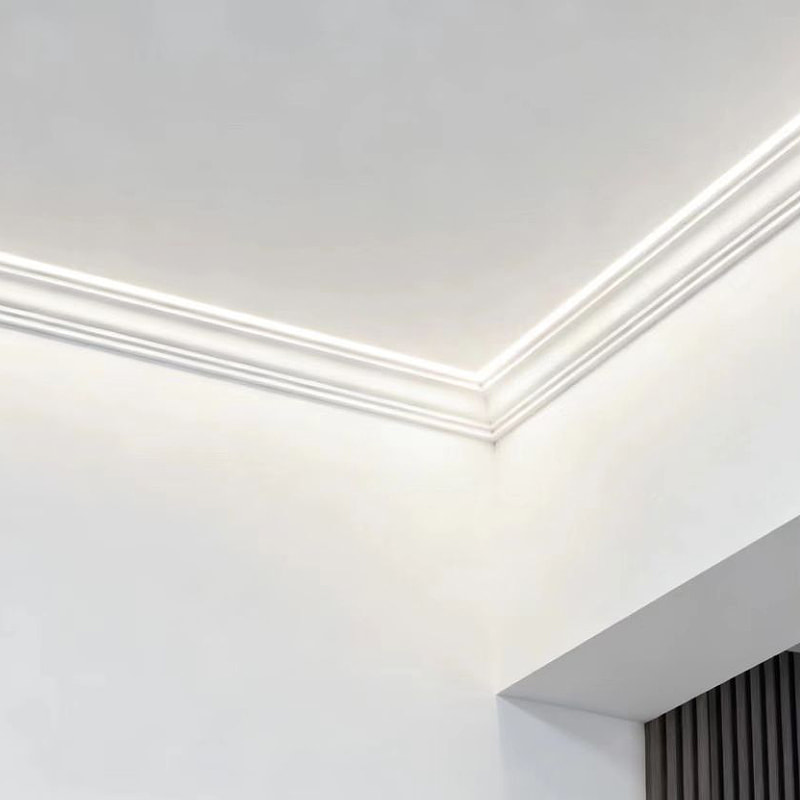
The finish has the final word because it dictates what the eye perceives at the ceiling line. For high ceilings, white-primed crown moulding is the dominant specification. A white or off-white crown recedes into the ceiling plane, which keeps the visual focus at living level; an accent colour pulls the ceiling down and makes the space feel more intimate.
Factory filler-primed pearl white is more than a coat of white paint. The primer fills the substrate’s micro-porosity, seals the surface against moisture absorption, and gives the painter a sanded, uniform foundation for the final top coat. On a tall ceiling you can apply two top coats in a single pass with a sprayer, instead of spending a full day priming and sanding on-site. The primed surface also accepts any quality water-based or alkyd top coat without blocking.
Beyond paint, PVC-wrapped crown profiles give you a factory finish that holds up in humid or coastal environments, and veneer-wrapped profiles replicate natural wood at a fraction of solid-stock cost. Our production line turns out more than 8,000 metres of painted moulding daily, which keeps colour and gloss consistent across large orders. To see the range of pre-primed options we offer, browse the full crown moulding collection.
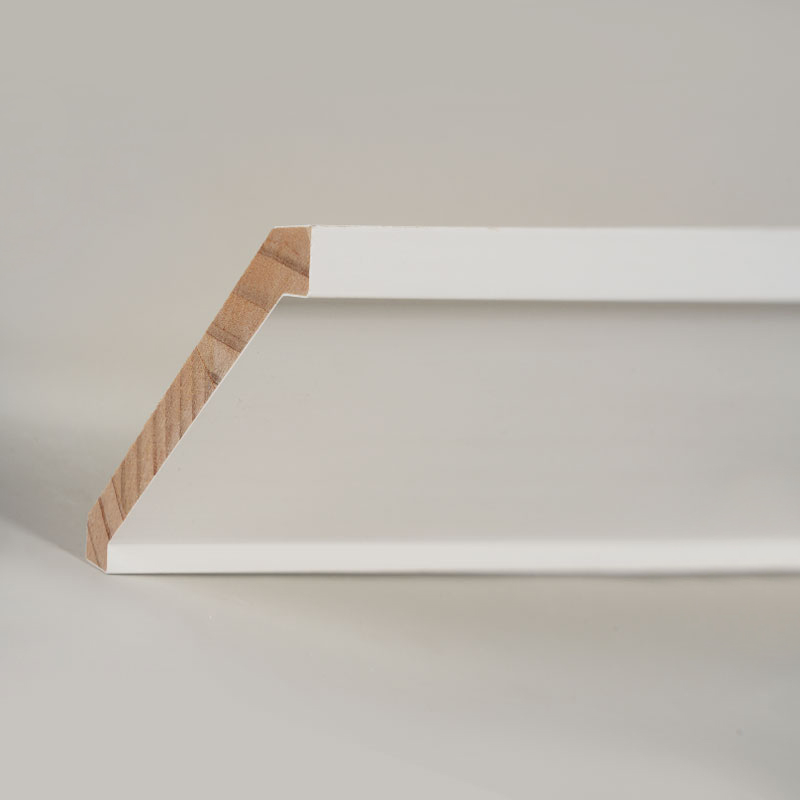
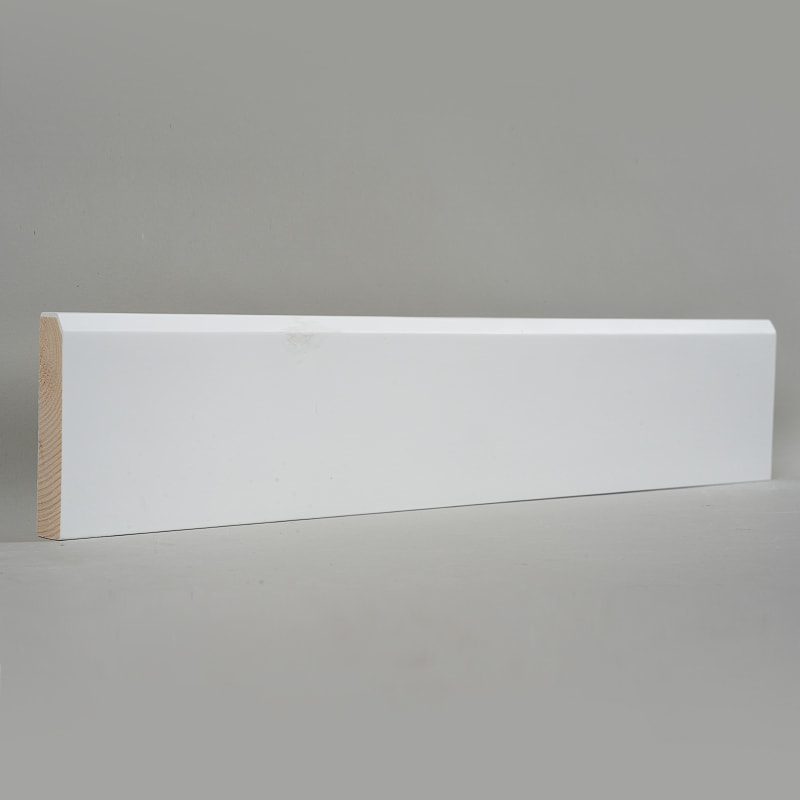 Customized White Primed Crown Moulding/Top Corner Moulding ManufacturersA white primed crown moulding is a decorative molding used at the junction of interior walls and ceilings (internal corners). Its core process involves applying specif...View Product →
FAQs About Crown Moulding for High Ceilings
Q1: What size crown moulding should I use for 10-foot ceilings?
Use a profile with a 5- to 6-inch face height for a 10-foot ceiling. In a small side room, a 4-inch profile works; in open-plan spaces, step up to 6-1/2 inches.
Q2: Does crown moulding make a high ceiling look higher or lower?
It depends on colour. Painted the same colour as the ceiling, crown recedes and makes the space feel slightly lower but more polished. Painted to match the wall, it emphasises the wall height and can make the ceiling appear taller.
Q3: Can I install crown moulding myself on high ceilings?
Yes, with a helper, a miter saw, a coping saw, and safe access. The main risk is cut accuracy at height: a mis-coped corner wastes both material and setup time. Dry-fit every joint before nailing.
Q4: Is MDF or pine better for crown moulding on tall walls?
For a painted, high-ceiling installation, MDF gives a smoother finish and better dimensional stability. Pine is lighter, easier to cut, and the right choice if you plan to stain. Both are available pre-primed.
A high ceiling is a design asset only when the trim is scaled to own it. Match the crown height to the wall height, choose a material that behaves at long spans, and order pre-primed profiles whenever you want a cleaner finish cycle. Huicheng has produced crown moulding and decorative millwork since 2002, with a daily output exceeding 15,000 linear metres across all profiles. If you are sizing a high-ceiling project now, take the ceiling height as your starting point, then let the profile follow from there.