 English
 Español
The Comprehensive Science of Acoustic Insulation in Modern Construction
In the contemporary architectural landscape, the management of sound has evolved from a luxury consideration to a fundamental requirement of interior design. As urban density increases, the demand for effective acoustic barriers has led to the development of advanced synthetic materials. Among these, PVC Soundproof Panels have emerged as a versatile solution for both residential and commercial environments seeking to mitigate noise pollution. Understanding the effectiveness of these materials requires a deep dive into the Sound Transmission Class (STC) rating system, which serves as the global benchmark for measuring how well a building partition attenuates airborne sound.
Soundproofing is not merely about blocking noise; it is about managing the energy transfer between spaces. When sound waves encounter a surface, they are either reflected, absorbed, or transmitted through the material. Traditional materials like concrete or heavy timber rely on pure mass to stop sound, but modern PVC composites utilize a combination of density, internal damping, and surface geometry. This article provides a technical exploration of how PVC-based systems perform under standardized testing and what users can realistically expect from their installation in various structural contexts.
The complexity of acoustics means that a single number rarely tells the whole story. However, the STC rating provides a standardized method to compare different wall treatments. For those considering PVC Soundproof Panels, it is essential to recognize that the final performance is a result of the panel’s chemical composition, its thickness, and the integrity of the installation process. By analyzing these factors, we can determine the specific role these panels play in creating quiet, productive, and private interior spaces.
Defining the Sound Transmission Class (STC) Framework
The Sound Transmission Class is an integer rating that quantifies how well a wall, floor, or ceiling assembly reduces the transmission of airborne sound, such as speech, television audio, or office equipment. The rating is derived from measuring the transmission loss across a range of frequencies, specifically from 125 Hz to 4000 Hz. This range covers the majority of common indoor sounds that cause distractions or privacy concerns.
The Significance of STC Increments
It is important to understand that the STC scale is logarithmic. This means that a small numerical increase represents a significant improvement in perceived quietness. For example, an increase of 3 points in an STC rating is generally the smallest change noticeable to the human ear, while an increase of 10 points is perceived as a 50 percent reduction in noise levels.
- STC 25: Normal speech can be heard clearly through the wall.
- STC 35: Loud speech is audible but not intelligible.
- STC 45: Loud speech is barely audible; typical for high-quality residential construction.
- STC 50+: Loud speech is completely inaudible; essential for professional environments or shared apartment walls.
Acoustic Performance of PVC Soundproof Panels
PVC (Polyvinyl Chloride) panels designed for acoustic use are engineered with specific additives to increase their density and flexibility. Unlike rigid plastics, acoustic-grade PVC often incorporates mineral fillers that improve its "damping" characteristics, allowing the material to convert sound energy into trace amounts of heat rather than vibrating and passing the sound through.
Typical STC Values for PVC Solutions
Standard PVC wall panels generally provide an STC rating ranging from 20 to 30 when measured as a standalone material. However, when these panels are integrated into a wall assembly—such as being applied over existing drywall or combined with an insulating core—the total assembly rating can reach STC 45 to 55. The specific rating depends heavily on the thickness of the PVC and the presence of hollow or solid cores.
| Panel Configuration | Estimated STC (Standalone) | Common Application |
| Hollow Core PVC Panel (5mm) | 22 - 25 | Decorative lining, minor noise dampening |
| Solid PVC Composite (8mm) | 28 - 32 | Office partitions, bedroom walls |
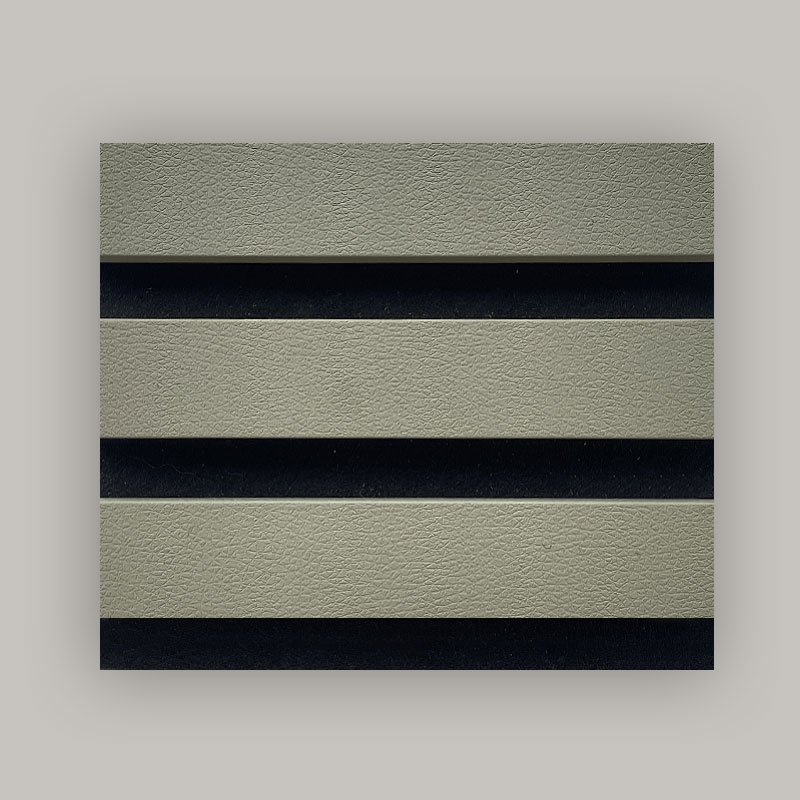
| PVC Grille with Acoustic Backing | 35 - 40 | Commercial lobbies, conference rooms |
Factors Influencing the Acoustic Efficacy of PVC
While the material properties of PVC are critical, several external factors dictate the actual sound reduction experienced by the end-user. To achieve the highest possible STC rating, architects and installers must consider the following variables:
1. Surface Density and Mass
The "Law of Mass" in acoustics states that doubling the mass of a partition generally results in a 6 dB increase in sound insulation. High-quality PVC soundproof panels are often manufactured with high-density additives to maximize mass without the extreme weight of lead or steel. This makes them ideal for retrofit projects where the existing structure cannot support heavy masonry.
2. Internal Air Cavities
Many PVC panels utilize a "fluted" or hollow-core design. While this reduces weight and cost, it can sometimes create resonance if the cavities are not properly managed. Advanced acoustic panels may fill these cavities with sound-dampening foam or provide a specific geometry that breaks up sound waves, effectively increasing the path length the sound must travel.
3. Decoupling and Vibration Control
Sound travels easily through rigid structures. If a PVC panel is screwed directly into a wall stud without any buffer, it may act as a bridge for vibration. Using flexible adhesives or mounting clips allows the panel to "decouple" from the main structure, preventing sound from vibrating through the studs and into the adjacent room.
Practical Benefits of PVC Panels Beyond Soundproofing
The selection of PVC as a soundproofing material is often driven by its multi-functional nature. In many industrial and commercial settings, acoustic performance is only one of several requirements. PVC offers a unique combination of physical properties that make it superior to traditional drywall or wood panels in specific environments.
- Moisture Resistance: PVC is naturally waterproof, making it the primary choice for soundproofing in basements, kitchens, or humid industrial zones where mineral wool or wood would degrade.
- Ease of Maintenance: The non-porous surface of PVC panels allows for easy cleaning and sterilization, which is vital in medical or food-processing facilities.
- Durability: High-impact resistance ensures that the panels maintain their acoustic integrity even in high-traffic areas where they might be subject to physical wear.
- Fire Retardancy: Most modern acoustic PVC panels are treated with flame retardants, meeting strict commercial building codes for safety.
Installation Strategies for Maximizing STC Performance
Even the highest-rated PVC panel will fail to deliver results if the installation is flawed. Sound behaves like water; it will find the smallest gap or "leak" to bypass a barrier. To ensure that the theoretical STC rating is achieved in a real-world setting, professional installers adhere to several critical guidelines.
Sealing the Perimeters
The edges where PVC panels meet the floor, ceiling, or adjacent walls must be hermetically sealed. Acoustical sealants—which remain flexible over time—are used to fill gaps. A gap as small as 1 percent of the wall surface area can reduce the overall STC rating of the wall by as much as 10 points.
Management of Electrical Outlets and Penetrations
Every hole cut into a soundproof panel for an outlet or light switch creates a path for noise. In high-STC installations, "putty pads" are used to wrap the back of electrical boxes, and staggered outlet placement is utilized so that boxes on opposite sides of a wall are not sharing the same air space.
Comparing PVC to Alternative Soundproofing Materials
To appreciate the value of PVC panels, it is helpful to compare them against traditional acoustic treatments. Each material has a specific use case based on budget, space constraints, and aesthetic goals.
- Mass Loaded Vinyl (MLV): While MLV is excellent for adding mass, it is a floppy, thin membrane that requires a supporting structure. PVC panels provide both the mass and the finished decorative surface in one product.
- Acoustic Drywall: Specialized drywall is effective but brittle and prone to water damage. PVC panels offer a more durable alternative in high-humidity or high-impact zones.
- Fiberglass Batts: These are used inside wall cavities. PVC panels are used on the exterior of the wall, making them a "finishing" solution that also contributes to sound blocking.
Future Trends in PVC Acoustic Technology
The field of acoustic science is constantly progressing. Recent innovations in the manufacture of PVC panels include the use of recycled content and the development of "micro-perforated" surfaces. These micro-perforations allow a panel to act as both a sound blocker (high STC) and a sound absorber (high Noise Reduction Coefficient, or NRC), providing a dual-action benefit that was previously difficult to achieve with synthetic plastics.
Furthermore, the integration of 3D printing technology is allowing for the creation of PVC panels with internal geometries specifically tuned to cancel out certain frequencies, such as the low-frequency hum of industrial machinery or the high-frequency whine of HVAC systems. As these technologies mature, the STC ratings for lightweight PVC solutions are expected to climb even higher.
Frequently Asked Questions (FAQ)
Q1: Can PVC panels block low-frequency bass noise?
A1: Low-frequency sound has long wavelengths that are difficult for any thin material to block. While solid PVC panels provide decent mid-to-high frequency insulation, blocking deep bass usually requires adding significant mass (like multiple layers) or creating a large air gap between the panel and the structure.
Q2: Are PVC soundproof panels safe for indoor air quality?
A2: High-quality modern PVC panels are manufactured to be low-VOC (Volatile Organic Compounds) and are free from harmful phthalates. They are widely used in hospitals and schools due to their hygienic properties and stable chemical nature.
Q3: How much do PVC panels improve the STC of an existing wall?
A3: Adding a high-density PVC panel over an existing single-stud drywall can improve the overall STC rating by 5 to 10 points, depending on the thickness of the panel and whether a damping adhesive is used during the installation.
Q4: Is a higher STC rating always better?
A4: Generally, yes, for sound blocking. However, it is important to match the rating to the need. An STC of 50 is ideal for a bedroom, but for a simple office partition where some privacy is needed but total silence is not required, an STC of 35-40 may be more cost-effective.
Q5: Can I install these panels myself to achieve these ratings?
A5: While DIY installation is possible, achieving the professional STC rating requires meticulous attention to "sound leaks." Using professional-grade acoustic sealants and ensuring no gaps are left at the floor or ceiling is crucial for success.